
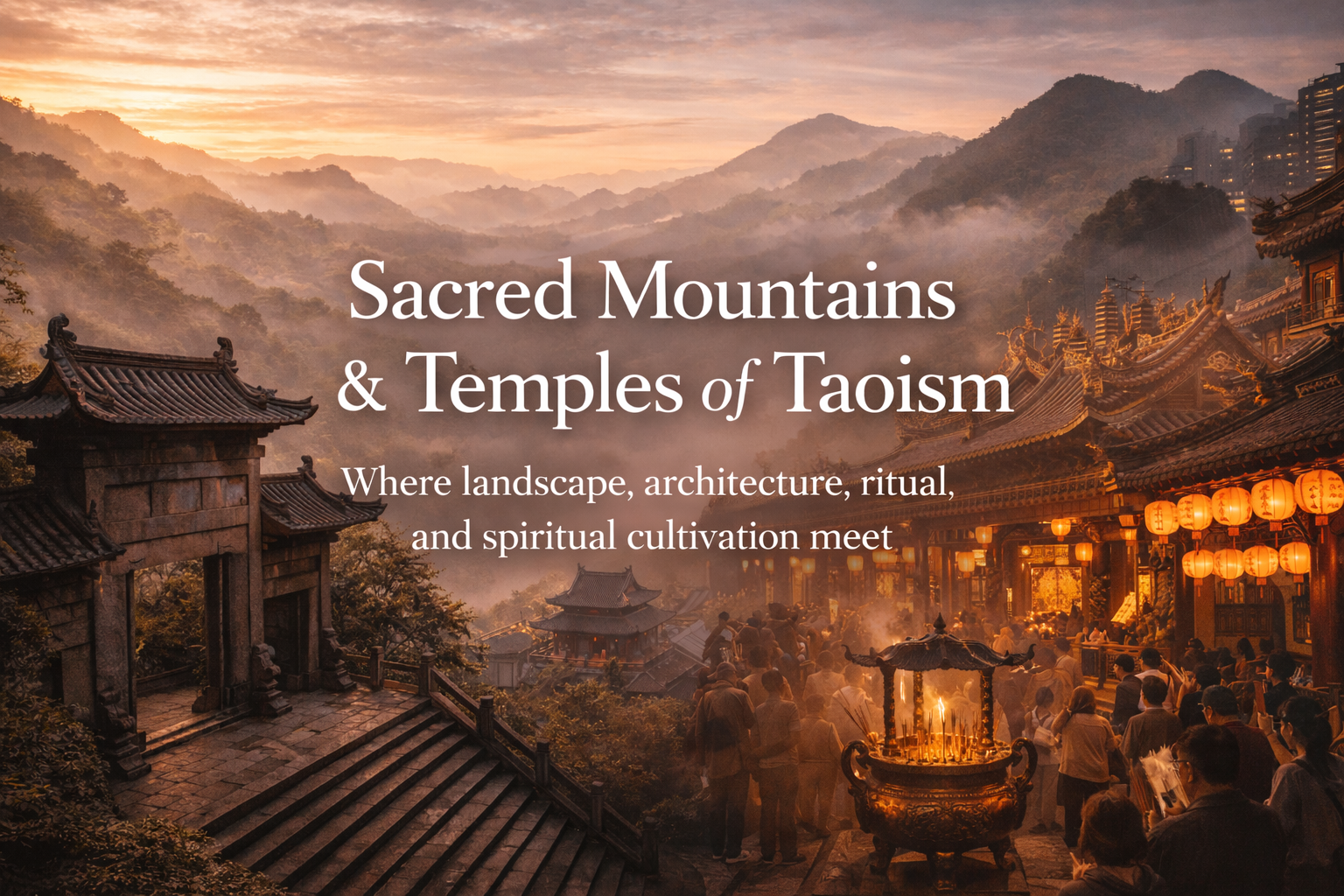
Sacred Mountains & Temples of Taoism
Eight sacred places in the living geography of the Tao.
In Taoist tradition, mountains are not only landscapes. They are places of revelation, retreat, and cultivation — where mist, stone, wind, and silence become part of spiritual practice. Temples, too, are more than monuments. They are living spaces of ritual, prayer, memory, and community.
From the high peaks of Wudang to the temple courtyards of Beijing, Taipei, and Singapore, this series explores the sacred spaces where Taoism has endured across centuries. Together, these mountains and temples form a spiritual map of Taoist tradition — one shaped by philosophy, devotion, architecture, and the rhythms of daily life.
Explore the sacred mountains and temples where Taoist philosophy has taken form in landscape, ritual, and living tradition.
-
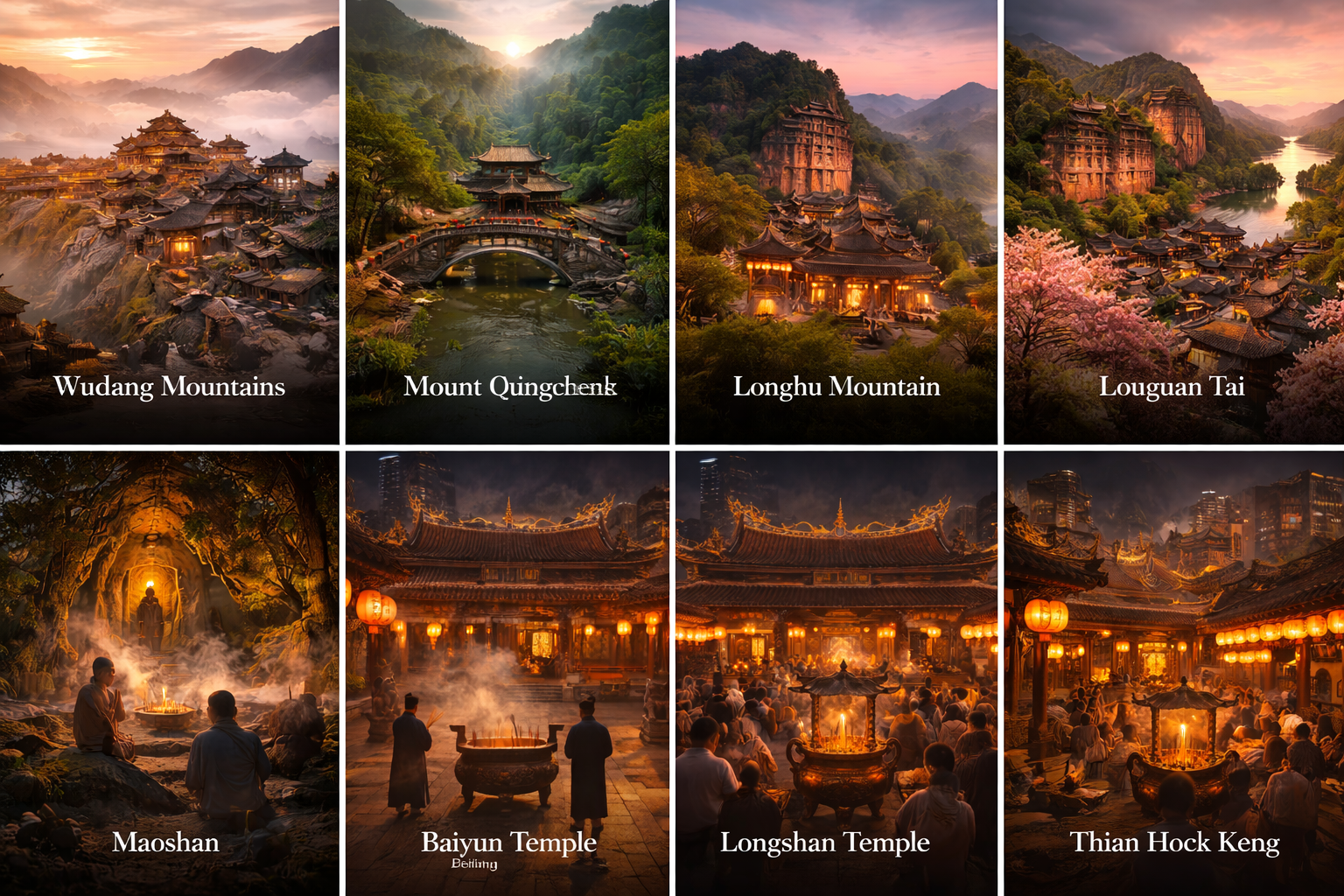
Wudang Mountains
The Wudang Mountains are one of Taoism’s most revered sacred landscapes, where cliffside temples, mountain monasteries, and internal martial arts traditions have shaped centuries of spiritual cultivation. -
Mount Qingcheng
Mount Qingcheng is considered the birthplace of organized Taoism, where the teachings of Zhang Daoling helped establish one of the earliest Taoist religious traditions. -
Longhu Mountain
Longhu Mountain, known as Dragon Tiger Mountain, became the historic seat of the Celestial Masters and a center of Taoist ritual authority for generations. -
Maoshan
Maoshan is a sacred mountain associated with the Shangqing school of Taoism, known for its meditation caves, mystical revelations, and traditions of inner cultivation. -
Louguan Tai
Louguan Tai is traditionally believed to be the place where Laozi recorded the Tao Te Ching before departing westward into legend. -
Baiyun Temple
Baiyun Temple in Beijing serves as one of the most important monasteries of the Quanzhen tradition and remains an active center of Taoist religious life. -
Longshan Temple
Longshan Temple in Taipei is a vibrant center of living devotion where incense, prayer, and divination rituals continue to shape daily spiritual life. -
Thian Hock Keng
Thian Hock Keng in Singapore is a historic temple built by Chinese immigrants that preserves Taoist worship and maritime traditions far from their original homeland.