
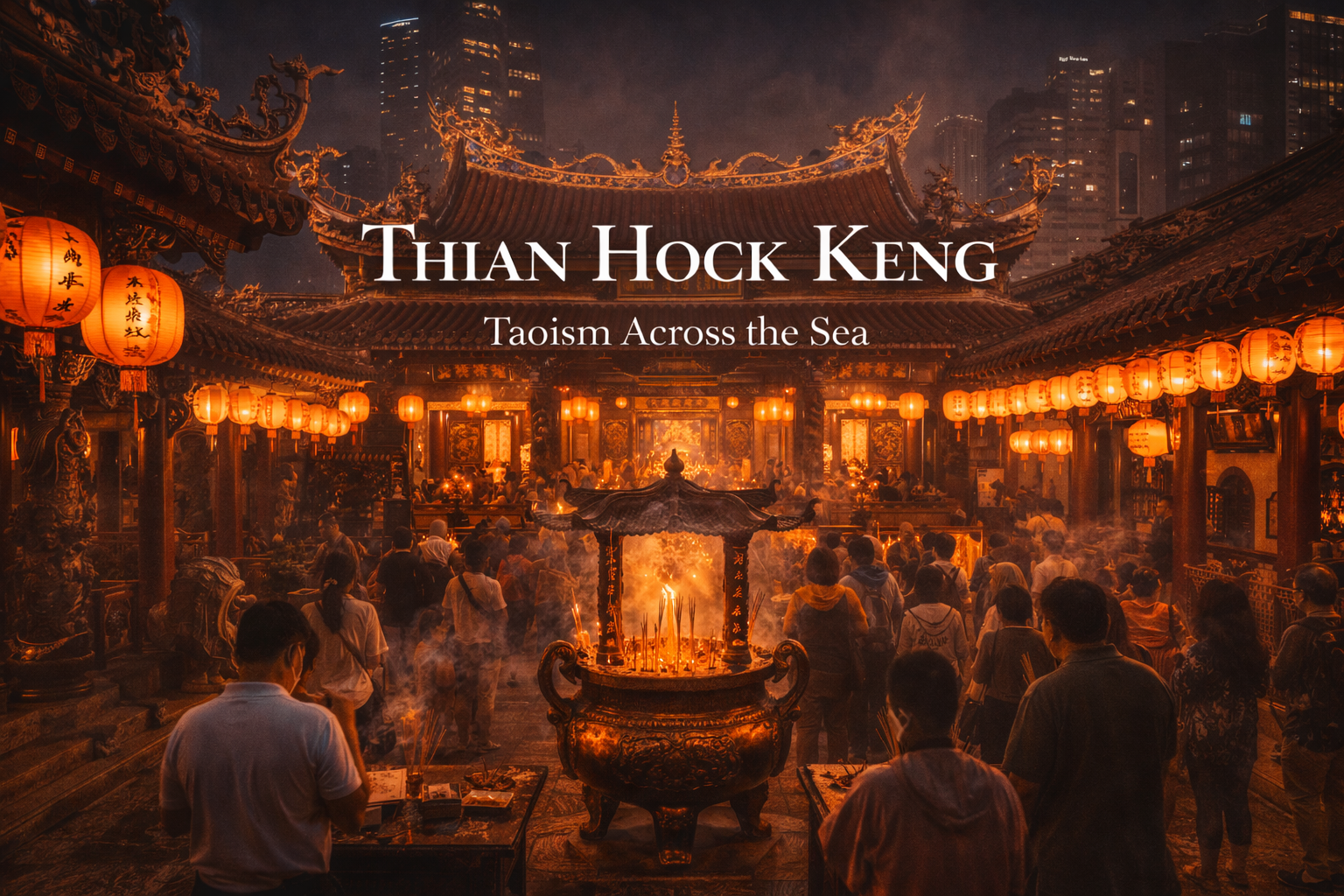
Thian Hock Keng (Singapore)
Taoism Across the Sea
In the heart of Singapore’s historic Chinatown stands Thian Hock Keng, one of the most important Chinese temples in Southeast Asia. Built in the early nineteenth century by Chinese immigrants arriving by sea, the temple served as both a place of worship and a spiritual refuge for travelers far from home.
The name Thian Hock Keng translates roughly to “Temple of Heavenly Happiness.” The temple is dedicated primarily to the sea goddess Mazu, who was believed to protect sailors and fishermen during dangerous voyages across the South China Sea.
For many immigrants arriving in Singapore during the nineteenth century, the temple was the first place they visited after reaching land. Sailors and merchants would come directly from the docks to offer incense and give thanks for safe passage across the ocean.
Architecturally, Thian Hock Keng reflects traditional southern Chinese temple design. Its sweeping tiled roofs are decorated with intricate ceramic dragons, phoenixes, and mythological figures, while the wooden beams inside the temple are carved with scenes from Chinese folklore and religious history.
Despite the modern skyline that now surrounds it, the temple remains an active center of religious life. Lanterns glow beneath the eaves, incense smoke rises from bronze burners, and worshippers continue to offer prayers much as their ancestors did generations ago.
Thian Hock Keng represents the final chapter in the story of Taoist sacred spaces. While the mountains and temples of China shaped the philosophical and spiritual foundations of Taoism, temples like this one show how the tradition traveled across oceans with migrating communities.
In places like Singapore, Taoism adapted to new landscapes while preserving its rituals, symbols, and connection to the rhythms of everyday life.