
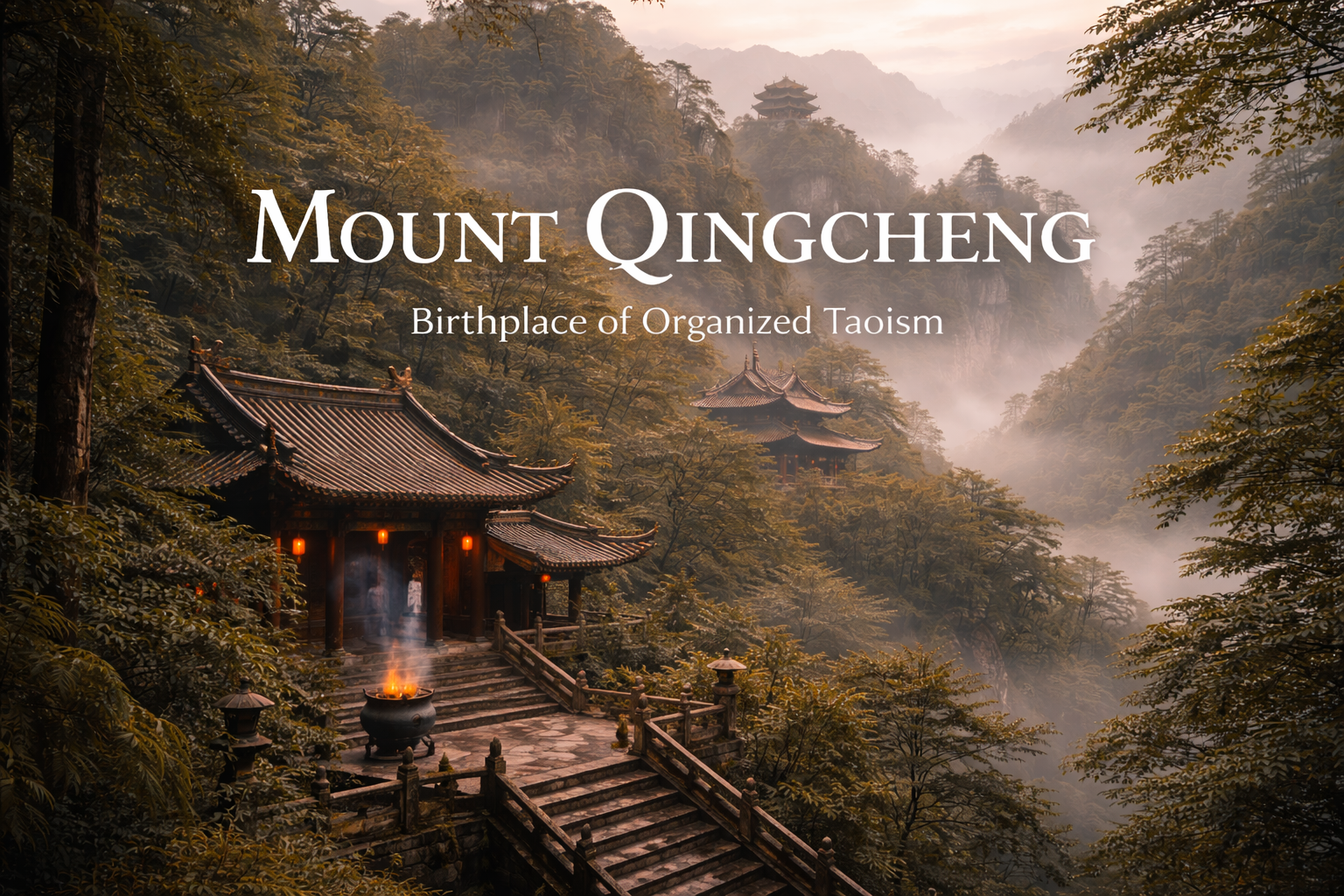
Mount Qingcheng
Birthplace of Organized Taoism
Hidden in the lush forests of Sichuan province, Mount Qingcheng rises quietly from the Chengdu plain. Unlike the dramatic cliffs of Wudang, Qingcheng is known for its deep green valleys, winding stone paths, and temples nestled among ancient trees. For more than two thousand years, this mountain has been associated with the early development of Taoism as a religious tradition.
According to historical records, Mount Qingcheng is closely linked to Zhang Daoling, the founder of the Celestial Masters movement in the second century CE. His teachings helped transform Taoist philosophy into an organized religious community with priests, rituals, and sacred texts. Because of this association, Qingcheng is often described as the birthplace of organized Taoism.
Walking through Qingcheng’s forested slopes reveals a landscape designed for quiet contemplation. Narrow paths lead past moss-covered gates and wooden temples hidden beneath tall cedar and bamboo. Incense smoke drifts from small shrines while the sound of flowing water echoes through the valleys. The mountain’s atmosphere feels less like a grand monument and more like a secluded spiritual refuge.
Many of the temples that stand today were rebuilt during later dynasties, but the mountain’s role as a center of Taoist practice has continued across centuries. Monks and practitioners have long come to Qingcheng to study meditation, ritual traditions, and classical Taoist philosophy. The surrounding forests were once dotted with hermit dwellings where practitioners sought solitude for cultivation.
What makes Mount Qingcheng unique is its sense of harmony between architecture and landscape. Rather than dominating the mountain, temples appear almost hidden within it. Stone stairways disappear into groves of bamboo, and small courtyards open suddenly within the forest. The mountain seems to invite slow wandering rather than dramatic pilgrimage.
Today Qingcheng remains both a pilgrimage site and a place of cultural memory. Visitors come not only to see the temples but to experience the quiet environment that shaped early Taoist religious life. In the shade of ancient trees and along paths worn smooth by centuries of footsteps, the mountain continues to embody a central Taoist principle: that spiritual understanding grows naturally from harmony with the living world.