
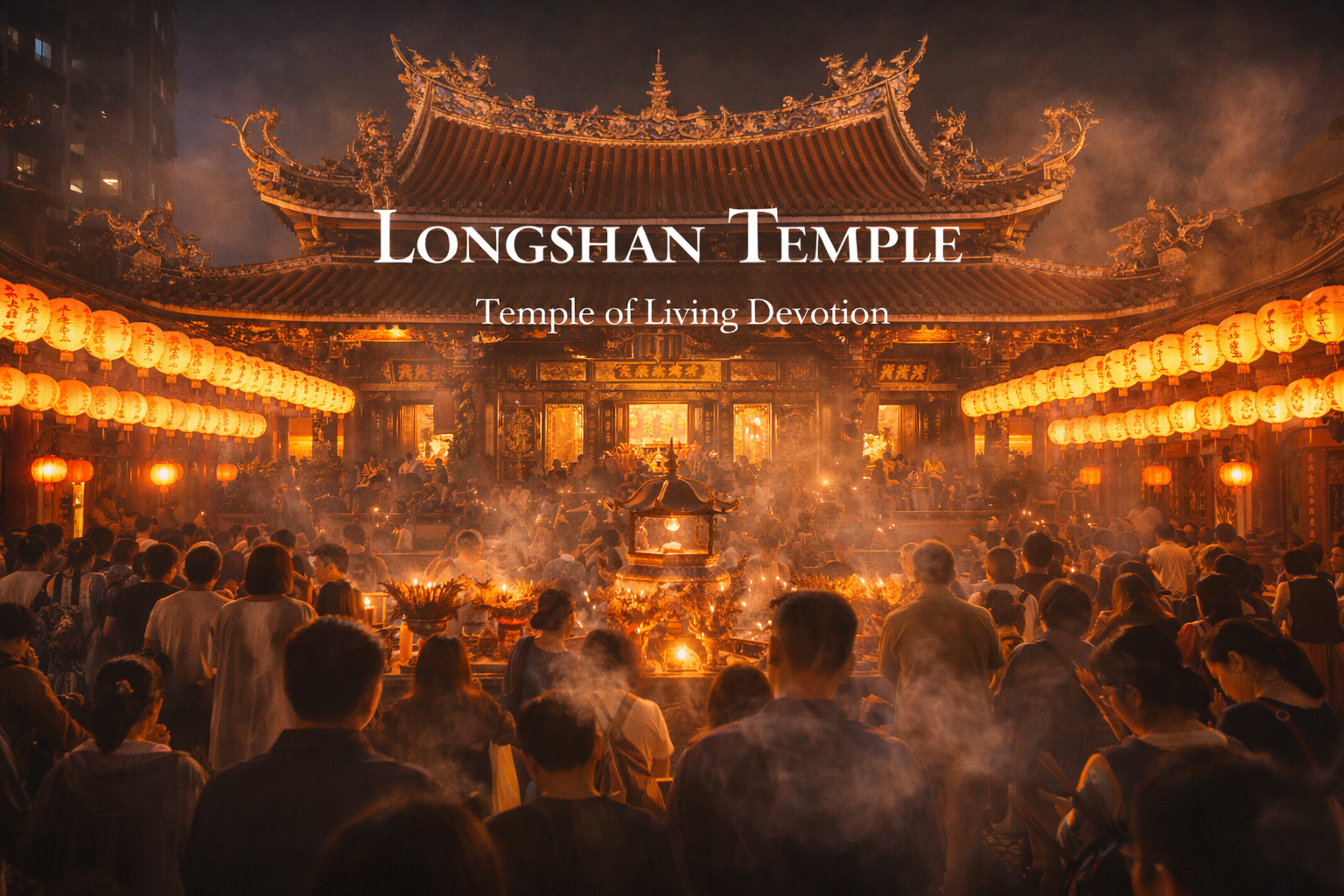
Longshan Temple (Taipei)
Temple of Living Devotion
In the historic Wanhua district of Taipei, Longshan Temple stands as one of the most vibrant centers of traditional religious life in Taiwan. Unlike the quiet mountain monasteries or scholarly temple complexes found elsewhere in Taoist history, Longshan Temple is alive with the rhythms of daily devotion.
Built in 1738 by settlers from Fujian province, the temple quickly became a spiritual center for immigrant communities. Over time it evolved into a place where multiple religious traditions intersect, blending Taoist practice with elements of Buddhism and local folk belief.
Throughout the day the temple courtyard fills with visitors carrying incense sticks, offerings, and prayer slips. The air is thick with the scent of burning incense while lanterns glow beneath elaborately carved roofs. Worshippers bow before altars dedicated to a wide range of deities, seeking guidance, protection, and blessings.
One of the temple’s most distinctive traditions involves the use of divination blocks, small crescent-shaped wooden pieces used to seek answers from the gods. Visitors kneel before the altar, ask a question silently, and cast the blocks onto the floor. Their position determines whether the answer is favorable or uncertain.
Despite earthquakes, war damage, and modernization, Longshan Temple has remained a center of community life for nearly three centuries. Festivals, seasonal rituals, and daily worship continue to draw both local residents and travelers who come to experience one of the most active temples in the Chinese world.
Where the sacred mountains represent retreat and the monasteries represent disciplined study, Longshan Temple represents something equally important in Taoism: the living connection between spiritual tradition and everyday life.