
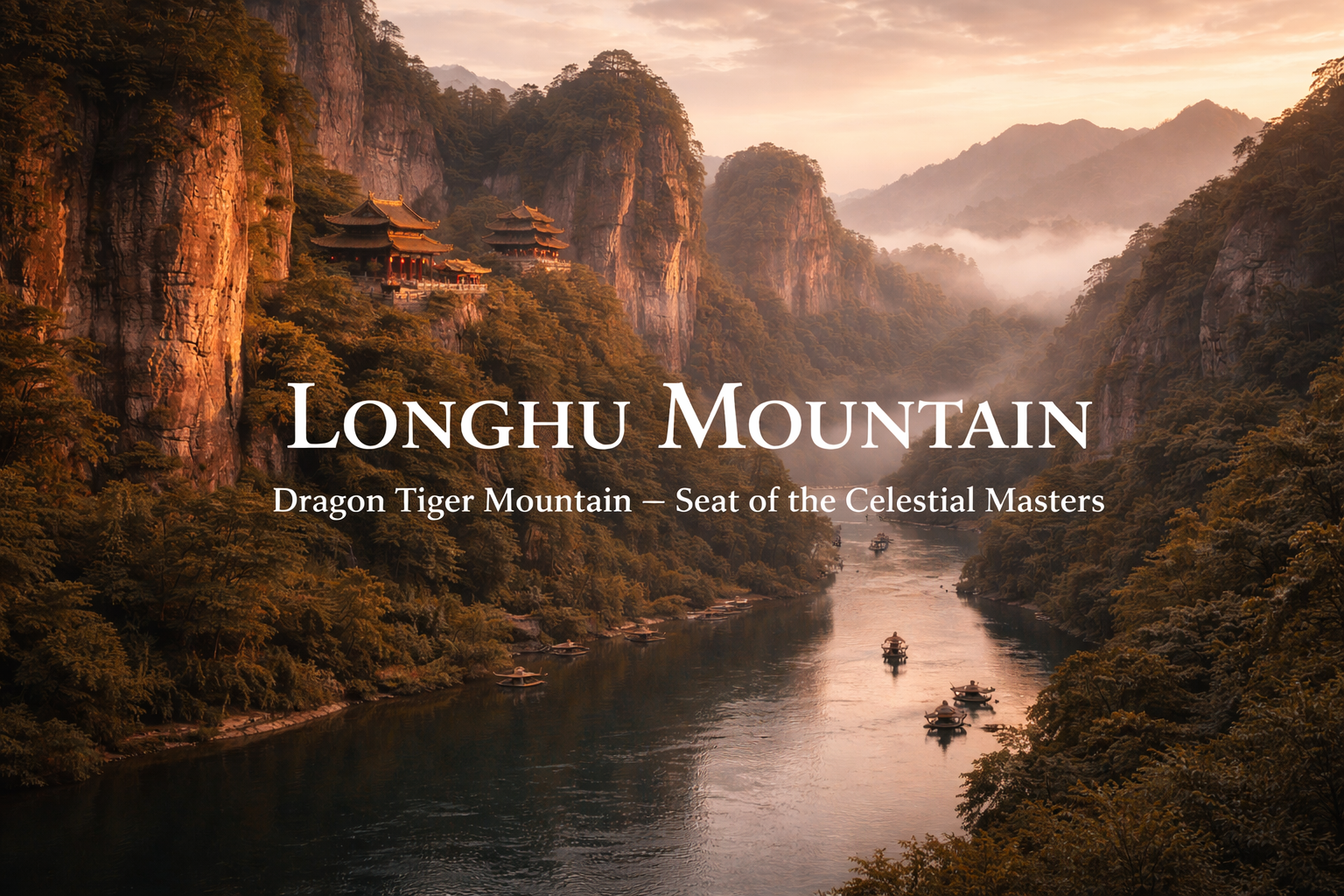
Longhu Mountain
Dragon Tiger Mountain — Seat of the Celestial Masters
Rising above the winding rivers and sandstone cliffs of Jiangxi province, Longhu Mountain, or Dragon Tiger Mountain, has long been regarded as one of the most important sacred landscapes in Taoism. The mountain’s name evokes the powerful imagery of two legendary creatures—symbols of balance, cosmic energy, and spiritual transformation.
Longhu Mountain is closely connected with the Celestial Masters tradition, one of the earliest organized schools of Taoism. According to tradition, the descendants of Zhang Daoling, the founder associated with Mount Qingcheng, later established their spiritual headquarters here. For centuries the Celestial Masters lineage maintained ritual authority from this mountain, guiding Taoist communities across China.
The geography of Longhu Mountain is strikingly different from the forested slopes of Qingcheng or the dramatic peaks of Wudang. Here the landscape is shaped by towering red sandstone cliffs that rise above quiet rivers and wooded valleys. Ancient caves carved into the rock once served as meditation sites and hermit dwellings, while temples and shrines were built along the cliffs and riverbanks.
Visitors to Longhu Mountain often travel by boat along the river that winds through the valley. From the water, the cliffs appear almost vertical, their surfaces marked by caves, ancient tombs, and temple structures. The stillness of the river reflects the surrounding mountains, creating a landscape that feels both powerful and contemplative.
Throughout history Longhu Mountain has remained a center of Taoist ritual life. Priests associated with the Celestial Masters lineage performed ceremonies related to healing, protection, and the regulation of spiritual forces within communities. These ritual traditions helped establish Taoism as a living religious system practiced throughout Chinese society.
Today the mountain continues to attract pilgrims, practitioners, and travelers drawn to its unique blend of natural beauty and spiritual history. The cliffs, caves, and temples of Longhu Mountain stand as reminders of the moment when Taoism evolved from a philosophical tradition into a structured religious culture that shaped communities for centuries.