
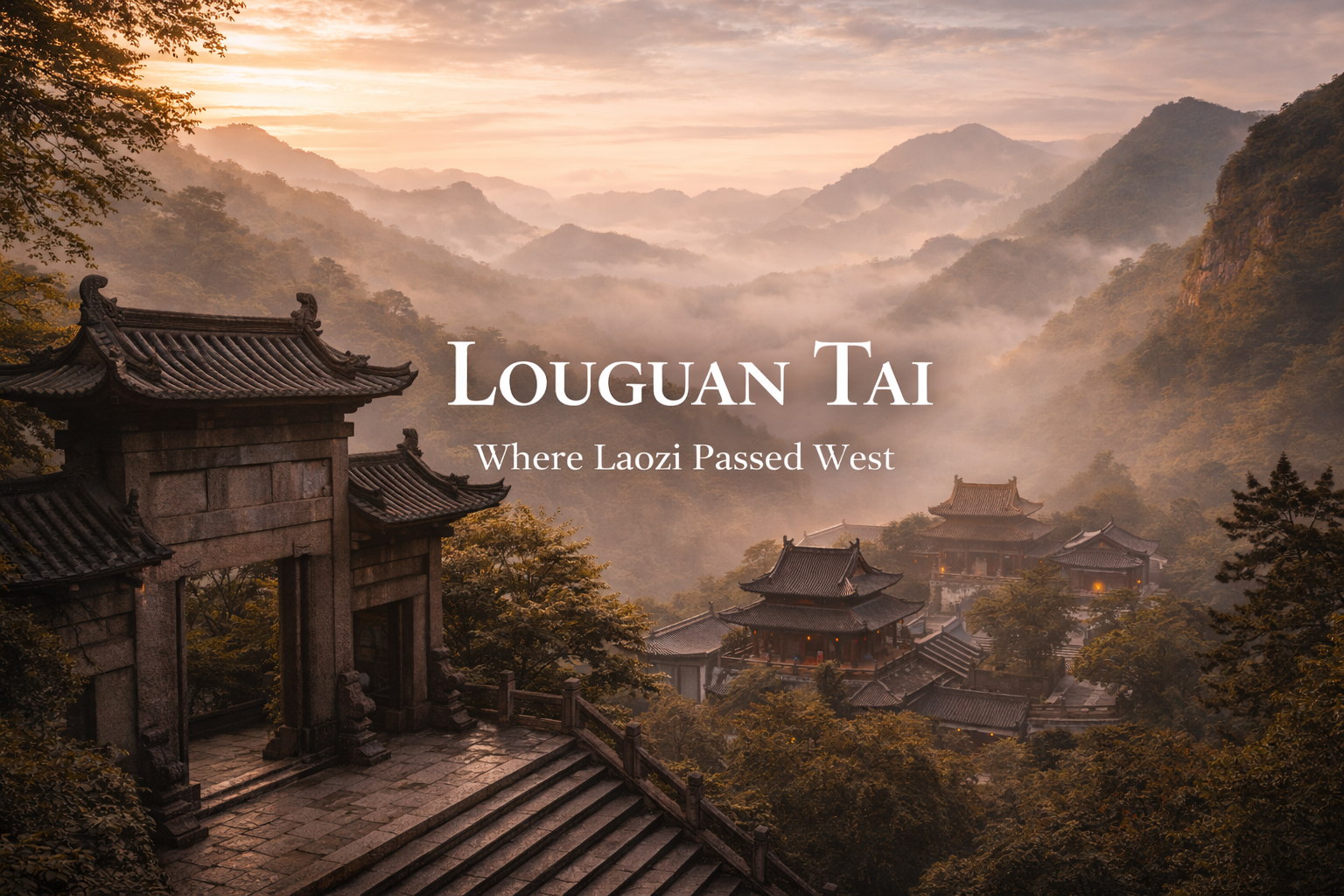
Louguan Tai
Where Laozi Passed West
Nestled at the foothills of the Qinling Mountains in Shaanxi province, Louguan Tai holds a special place in the history of Taoism. While many sacred mountains are associated with spiritual cultivation or religious institutions, Louguan Tai is connected to one of the most enduring legends in Chinese philosophy—the story of Laozi and the writing of the Tao Te Ching.
According to tradition, Laozi served as an archivist during the late Zhou dynasty. As political instability spread across the empire, he chose to leave civilization behind and travel westward toward the mountains. When he reached the western gate of the empire, the gatekeeper Yin Xi recognized him as a great sage and asked him to record his teachings before departing.
It was here, at the place now known as Louguan Tai, that Laozi is said to have written the Tao Te Ching, the short yet profound text that would become the foundation of Taoist philosophy. After completing the manuscript, the legend says Laozi continued westward, disappearing into the mountains and leaving his teachings behind.
Over time temples and monasteries were built at the site to honor this story. The name Louguan Tai, meaning “Lookout Tower Platform,” refers to the ancient observation tower that once stood near the pass where Laozi was believed to have stopped.
Today the temples of Louguan Tai stand quietly among forested hills at the northern edge of the Qinling range. Stone paths lead visitors through courtyards and gates dedicated to Laozi, while inscriptions of the Tao Te Ching can be found carved into stone tablets throughout the complex.
Unlike the towering peaks of Wudang or the misty forests of Qingcheng, Louguan Tai carries a different kind of significance. It represents not only a sacred landscape but also the symbolic birthplace of the philosophical text that shaped Taoist thought for more than two millennia.
To walk the grounds of Louguan Tai is to stand at the intersection of legend and philosophy—where the quiet wisdom of the Tao Te Ching first entered the world.