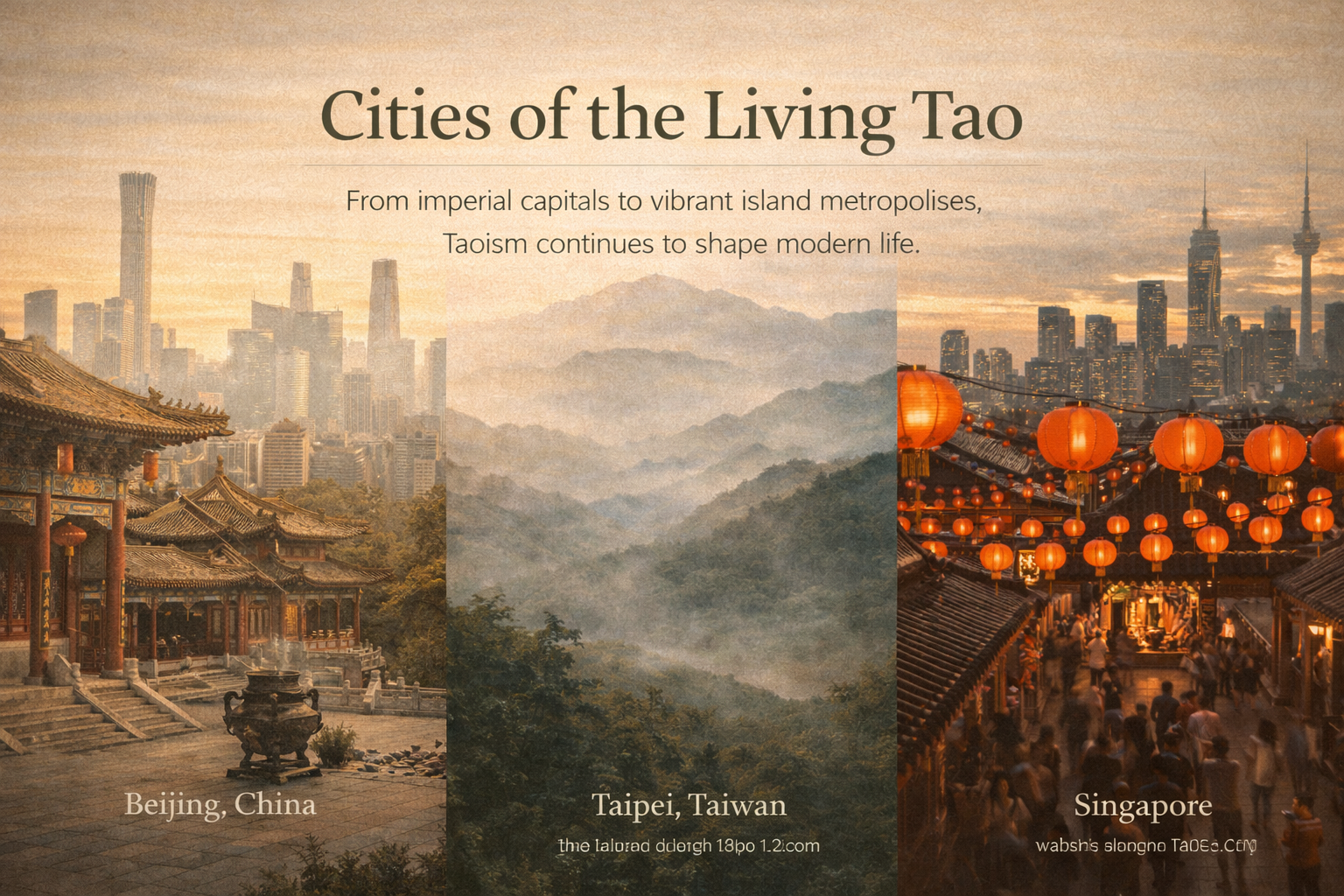
Expanded StoryTaoism is often imagined in remote mountain temples, far from the noise of modern civilization. Yet across Asia—and beyond—its philosophy, ritual life, and seasonal rhythms continue to thrive within dynamic urban centers. In some cities, Taoism anchors imperial history. In others, it shapes neighborhood culture, festival life, healing traditions, and daily devotion.
The following three cities—Beijing, Taipei, and Singapore—demonstrate how Taoism adapts, survives, and remains deeply relevant in contemporary society.

Beijing, China
Imperial Capital and Institutional Heart of Taoism
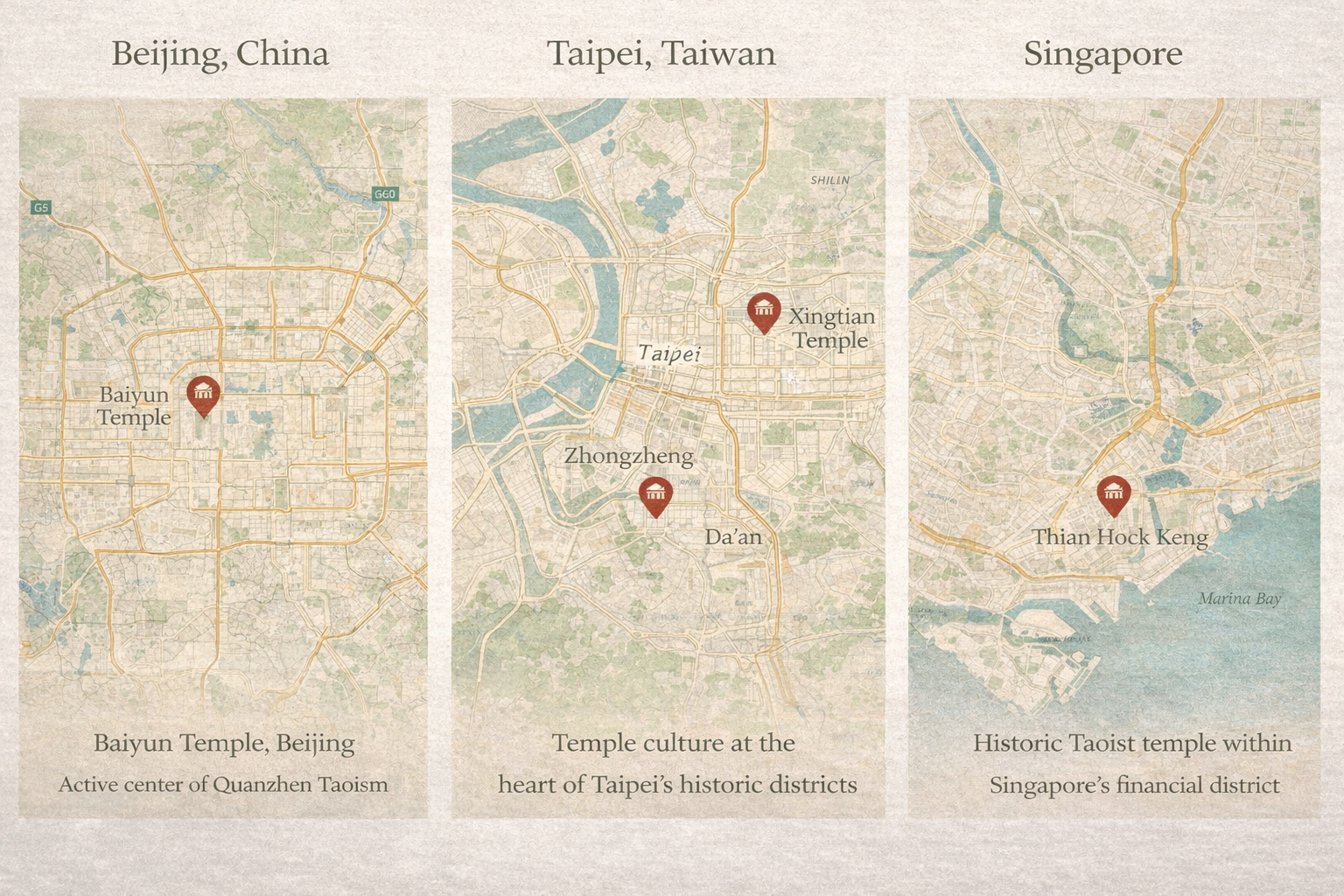
As China’s historic capital, Beijing has long been a crossroads of religious, philosophical, and political influence. Within this landscape stands Baiyun Temple (White Cloud Temple), one of the most significant institutions of Quanzhen Taoism. Founded during the Tang dynasty and expanded under Yuan and Ming patronage, it became a center for scriptural study, ritual training, and monastic administration.
Unlike mountain sanctuaries removed from daily life, Baiyun Temple exists within the fabric of a modern metropolis. Monks conduct daily liturgies while office workers pass beyond its walls. Seasonal festivals bring incense, offerings, and families seeking blessings. In city parks at dawn, residents practice taijiquan—movements rooted in Taoist cosmology—against a skyline of glass towers.
Beijing reveals Taoism not as relic, but as structured tradition sustained within state institutions and urban rhythm alike.
Temple Travel Guide: Beijing
“In Beijing, Taoism is not preserved behind glass — it breathes within the city itself.”
Best Time to Visit:
Spring and autumn offer mild weather and active temple life. Major lunar festival days bring visible ritual activity.
What to Observe Respectfully:
• Incense offering rituals
• Scriptural chanting (if public)
• Quiet morning meditation practice
Etiquette Tips:
• Dress modestly
• Avoid interrupting prayer
• Photography may be restricted inside halls
Nearby Cultural Sites:
• Temple of Heaven
• Lama Temple
• Traditional medicine districts
🏯 Beijing, China
Imperial Capital and Institutional Heart of Taoism
Founded during the Tang dynasty and expanded through subsequent imperial eras, Baiyun Temple remains one of the most significant centers of Quanzhen Taoism. As an institutional and monastic hub, it has long shaped the study of Taoist scripture, liturgy, and philosophical cultivation. Yet Taoism in Beijing extends well beyond its temple walls
Community rituals tied to the lunar calendar continue to gather families and devotees for seasonal observances, prayer offerings, and festival ceremonies. Traditional Chinese medicine clinics throughout the city draw upon Taoist cosmology—yin-yang balance, five-element theory, and qi circulation—as foundational principles of healing. At dawn, public parks become spaces of quiet martial arts practice, where taijiquan and other internal disciplines reflect Taoism’s integration of body, breath, and intention.
In Beijing, Taoism remains structured yet accessible—an institutional tradition sustained within the rhythm of a modern capital.
Taipei, Taiwan
Temple Culture and Living Folk Taoism
In Taipei, Taoism is visible everywhere. Lanterns hang above busy streets. Incense coils burn through the afternoon. Temple drums echo during lunar celebrations.
Sites such as Longshan Temple and Xingtian Temple serve as both sacred space and civic center. Here, classical Taoist liturgy blends seamlessly with folk religious practices, ancestor reverence, divination rituals, and healing rites.
Taiwan’s open religious landscape has allowed Taoist processions, spirit-medium traditions, and public festivals to flourish visibly. During major celebrations, entire neighborhoods transform into ritual corridors. Offerings line sidewalks. Opera troupes perform before temple gates. Families participate together.
In Taipei, Taoism is not hidden or institutional—it is participatory, communal, and vibrantly alive.
Temple Travel Guide: Taipei
“In Taipei, ritual spills into the street, and the street becomes sacred.”
Best Time to Visit:
Lunar New Year, Ghost Festival, and major deity celebrations.
What to Observe Respectfully:
• Divination rituals (jiaobei blocks)
• Temple offerings
• Public festival processions
Etiquette Tips:
• Follow incense placement patterns
• Move clockwise when circling altars
• Avoid stepping over offerings
🏮 Taipei, Taiwan
Temple Culture and Living Folk Taoism
In Taipei, Taoism thrives as a vibrant communal force. Temples such as Longshan and Xingtian serve not only as sacred sites but as neighborhood centers where ritual life unfolds visibly and collectively. Community rituals are highly participatory—seasonal festivals, deity birthdays, and procession days transform streets into corridors of devotion.
Healing traditions are deeply integrated into temple culture. Devotees seek spiritual consultation, divination, herbal remedies, and blessings for health and harmony. Spirit-medium practices and ritual specialists continue to operate openly, reflecting a living continuity between ancient belief systems and contemporary needs.
Martial arts and qigong practices are equally present in daily life. Early morning gatherings in public parks reflect the embodied aspect of Taoist cultivation—movement as meditation, breath as alignment, discipline as balance.
In Taipei, Taoism is communal, expressive, and woven seamlessly into everyday life.
Singapore
Taoist Heritage in a Modern Global City
Singapore offers a striking contrast: a hyper-modern skyline rising beside century-old clan temples. Chinese immigrants carried Taoist practices to the island in the 19th century, establishing shrines and temples that remain active today.
Thian Hock Keng Temple, built by early Hokkien settlers, stands as both historical monument and functioning religious site. Though surrounded by financial districts, incense still rises from its courtyard.
Festivals such as the Hungry Ghost Festival transform neighborhoods. Temporary altars appear. Ritual offerings are made publicly. Traditional performances accompany rites meant to honor wandering spirits and maintain cosmic balance.
Singapore demonstrates Taoism’s adaptability: ancient ritual systems functioning within a global, technologically advanced society.
Temple Travel Guide: Singapore
“In Singapore, incense rises beneath glass towers — ancient rhythm within a modern skyline.”
Best Time to Visit:
Hungry Ghost Festival (7th lunar month)
Major temple anniversaries
What to Observe Respectfully:
• Temporary street altars
• Public opera performances
• Offerings left for wandering spirits
Etiquette Tips:
• Do not step on burned offering paper
• Be mindful of ritual space boundaries
• Observe quietly during ceremonies
🏙 Singapore
Tradition Within a Modern Global City
In Singapore, Taoist practice endures within one of the world’s most modern urban landscapes. Temples such as Thian Hock Keng remain active centers of worship and cultural preservation. Community rituals, particularly during the Hungry Ghost Festival, bring neighborhoods together through offerings, temporary altars, and traditional performances that honor ancestral and wandering spirits.
Healing traditions persist through temple-based consultations and the broader practice of traditional Chinese medicine, which continues to draw upon Taoist energetic principles. Though surrounded by skyscrapers, these practices maintain continuity with centuries-old cosmology.
Martial arts schools and qigong groups operate across the city, sustaining physical disciplines rooted in Taoist internal cultivation. Even within a global financial center, ritual, healing, and embodied practice remain visible threads in the urban fabric.
Singapore demonstrates Taoism’s adaptability—ancient spiritual systems functioning within contemporary global society without losing their ritual core.
-
We're a team of passionate thinkers and doers, dedicated to building with purpose and clarity. Collaboration and curiosity drive everything we do.
-
Longshan Temple, founded in the 18th century, remains one of the city’s most revered spiritual landmarks. Its carved beams, coiling incense spirals, and layered altars reveal a synthesis of Taoist, Buddhist, and folk religious traditions. Devotees move deliberately… Explore Now
-
As Singapore developed into a global trading hub, and later a modern financial center, the temple remained. Urban renewal transformed the surrounding districts, but its carved timber structures, ceramic figurines, and granite columns endured…. Explore Now