
Beijing, China
The Capital of Continuity
Taoism Between Imperial Walls and Morning Parks
Beijing is a city of layers. Dynasties rise and fall beneath its avenues; old courtyards persist behind new towers; ritual time moves quietly alongside the tempo of modern workdays. In this capital, Taoism is not only a living belief system—it is an institutional tradition, shaped by history, architecture, and the daily practices of ordinary people.
At the center of this continuity stands Baiyun Temple (White Cloud Temple), one of the most influential Taoist sites in China and a key spiritual home of Quanzhen (Complete Perfection) Taoism. Yet to understand Taoism in Beijing, you have to look beyond temple gates. Here, it exists in parks at dawn, in clinics and herb shops, in festival offerings, and in the city’s instinctive respect for cycles—seasonal, lunar, and human.

A Temple That Outlasts Empires
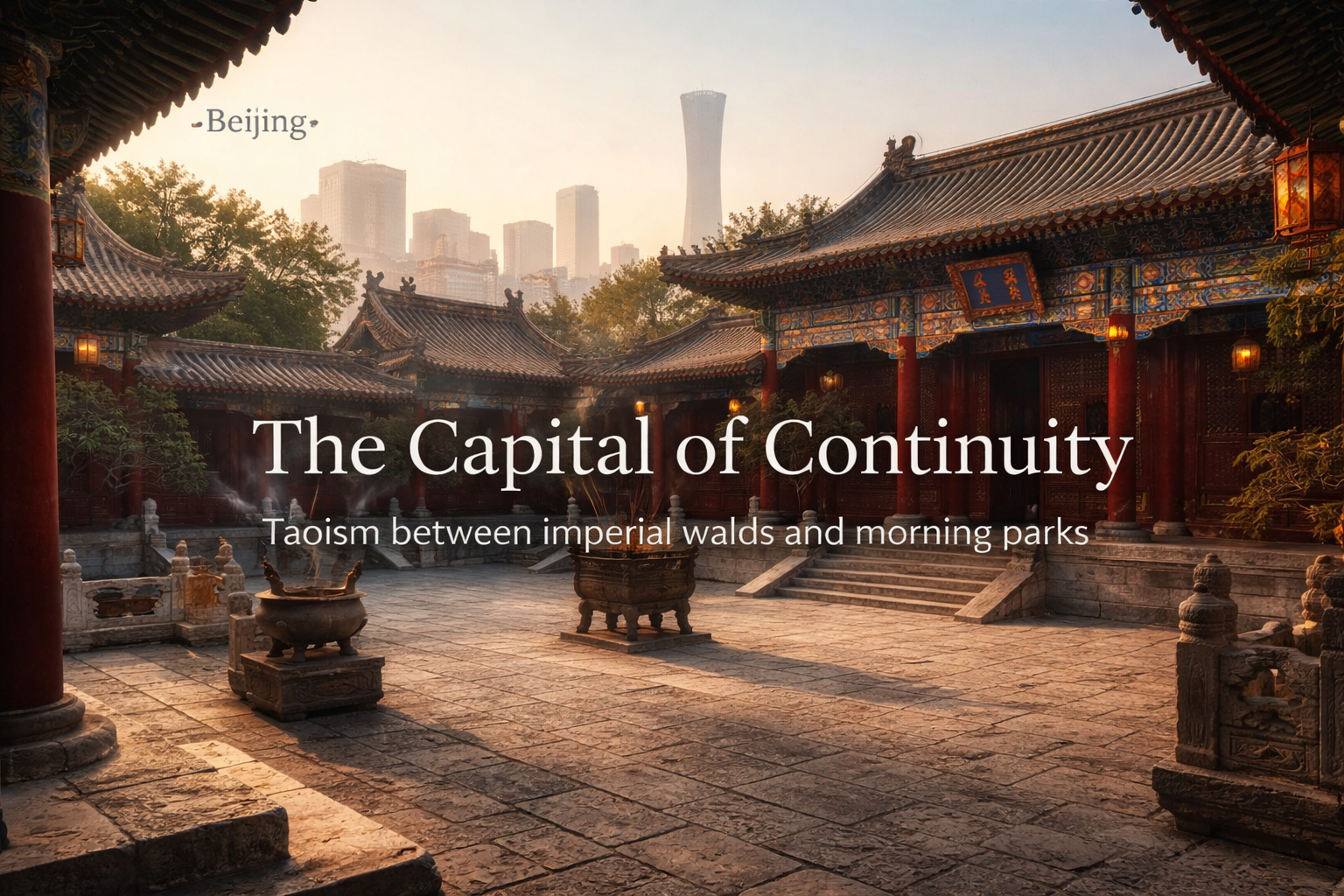
Baiyun Temple has been rebuilt, restored, and reimagined across centuries, but its role has remained remarkably consistent: it is a place of cultivation—spiritual, intellectual, and communal. Within its courtyards, the city’s noise seems to soften. Red pillars and carved beams frame quiet thresholds. Stone paths guide visitors through an environment designed to slow the mind, even when the world outside refuses to.
Baiyun is not a distant sanctuary. It is urban Taoism at its most grounded: accessible, structured, and enduring. Monastics maintain liturgy and discipline, while lay visitors arrive for prayer, reflection, and guidance. The temple becomes a bridge between formal tradition and daily need—a place where philosophy meets practice.
“In Beijing, Taoism does not retreat from the city—it steadies it.”

Community Rituals and the Lunar Rhythm
Beijing’s Taoism becomes most visible when time changes.
Lunar festivals and seasonal observances draw families into sacred routines: incense, offerings, bows, the quiet choreography of devotion. These rituals are not spectacles—they are repetition, continuity, a shared language passed down through generations. Even for those who don’t identify as religious, the gestures remain familiar: honoring ancestors, seeking blessings, marking transitions.
In a city defined by planning and productivity, Taoist ritual introduces another measure of time—cyclical rather than linear. It asks the city to remember that life moves in returns: day to night, winter to spring, loss to renewal.
Healing Traditions and the Taoist View of Health
In Beijing, Taoism also lives in the body.
Across the city, traditional Chinese medicine continues to draw on principles deeply compatible with Taoist cosmology: balance over force, harmony over control, prevention over reaction. The language of qi, yin-yang, and the five elements shapes how many people understand wellness—not as a single cure, but as an ongoing alignment.
Clinics and herbal shops become quiet extensions of the Taoist worldview. Remedies are seasonal. Diet is adjusted to climate. Rest and breath are treated as essential, not optional. In this sense, Taoism in Beijing is not always announced as Taoism. Often it appears simply as a way of living sensibly within nature’s patterns—even in a city of concrete.

Martial Arts at Dawn
If you want to see Taoism without walls, go to a Beijing park early in the morning.
Before the city fully wakes, the parks fill with slow movement: taijiquan forms unfolding like calligraphy in the air, qigong breathing synchronized to gentle shifts of weight, circles of older practitioners repeating sequences they’ve practiced for decades. There is discipline here, but also softness—strength expressed through control, not force.
These practices aren’t just exercise. They carry a philosophy: yield to redirect, relax to strengthen, stillness within motion. The Taoist body becomes a site of cultivation, a portable temple. And in a capital where stress can feel constant, these morning rituals are a quiet method of returning to balance.
“The most honest temple in Beijing may be the one people carry in their breath.”
Urban Taoism, Not Museum Taoism
Beijing’s Taoism is often misunderstood as something preserved—protected behind history, formalized into tradition, turned into “heritage.” But the city’s most compelling truth is that Taoism persists because it remains useful.
It offers:
a ritual language for change and uncertainty
a health philosophy grounded in balance
a discipline of the body that calms the mind
a seasonal rhythm that counters modern speed
Baiyun Temple anchors this continuity, but Beijing itself is the larger context—a living ecosystem where Taoist ideas survive not as relics, but as everyday tools